As you might have noticed, some aesthetic changes are underway on this blog. Changes not entirely by choice, it happened when I upgraded wordpress. I don’t think this look suits me but it will have to do for the time being. Welcome to Helevetica hell!
Since I am here I decided to share with you a song I’ve just heard today and instantly fell in love with. It’s from Fever Ray, a solo project of Karin Dreijer Andersson, one half member of The Knife. The album won’t be out until March but you can hear some of the songs on the Fever Ray website.
The video is absolutely brilliant, as British friends like to say. It looks like my dreams.
These two videos capture what I love most about Flamenco: the visceral emotion, the interconnectedness of everyone involved (not just the performers) and the history that is passed on through every letra, every gesture of the hands and pick of the guitar strings. The artists in these clips are not performing Flamenco, they are Flamenco. Flamenco puro is able to move me like nothing else – it’s like, the very essence of my being reverberates and responds to the music. I know this may sound cheesy but it is completely true.
The first is of Lole Montoya and her mother La Negra singing for Spanish television. In the time soon after this recording was made, Lola would join up with her partner Manuel Molina to create some of the most exciting Flamenco of the 70s, a fusion of traditional Flamenco rooted in compas and flamenco puro and mixed with Arabic and rock elements. Lole’s Arabic influences come from her youth spent living in North Africa with her Gitano family. The above video clip is one of the first documented forays into her Arabic influenced Flamenco, and I think it’s absolutely captivating. It is her voice that first pulled me into my journey of Flamenco discoveries and she remains one of my favorite cantaoras.
If there was a Flamenco heaven it would look a little like this clip. A room full of the best Flamenco artists joined together for a good-natured juerga. These people are my inspiration and the reason why I’ve devoted so much time and energy studying this art form. This little bit of celestial Flamenco could not be complete without Camaron de la Isla, one of the most innovative and talented Flamenco cantaores of this lifetime. Camaron is the one artist that can actually transmit duende through recordings (duende is an overused term to describe the extra sensory feelings that can be transmitted through Flamenco). What’s more intriguing about this clip is the amorous tension between Carmelilla Montoya (the dancer) and Camaron. The way she smiles, the way he smiles…ay!
A special treat: This tune, Sangre Gitana y Morena by Lole y Manuel uses some of the same Arabic letras taught to Lole by her mother in the clip above.
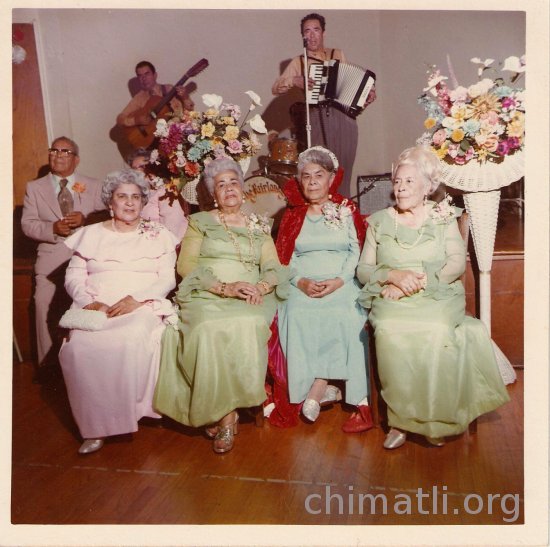
My great-grandmother in the red cape. Boyle Heights, 1975
Of all my family photos, this is definitely one of my favorites. It is of my great-grandmother Guadalupe Martinez (originally from Pastor Ortiz, Michoacan) at a presentation in her honor. She won out over the other women (presumably, her court) to be crowned “Grandmother of the Year.” According to family stories, the other ladies weren’t too happy about losing. It’s kinda apparent, no?
The dance took place at the CSO Center on Brooklyn Ave (Cesar Chavez) across the street from San Antonio de Padua church. I imagine my great-grandmother’s revered role as the founder of the Guadalupana’s club at the church and provider of the feria tamales and bunuelos contributed to her anointment. Strangely, her involvement with this church would benefit me even after her death and in the most unlikely of ways.
I love the band. You can just make out their name, The Fairlang, artfully done in the infamous Mexican Blackletter.
I’ve been reading and obsessed with the book The Savage Detectives and this song sort of captures the spirit of the book in a frenetic way.
(translation from a youtube comment with minor changes by me)
I’ve made my second grade exam in 1975
socialism was like the universe:in expansion
the teacher asked me of Max Robespierre
I told her that Jacobins were right despite the terror
the French Revolution was right indeed
She made no more questions
But we also have many remembrances of that little old world fogazzaro
The 300 hundred points Space Invaders spaceship
Enrico Berlinguer on TV
The Olympic winnings of Alberto Juan Torena in the name
of the Cuban revolution
The Sandinista power in Nicaragua
The cathechist who voted for Pannella
The friends who went from smoking marlboro to heroin (and then they say “the light drugs!”)
Zora’s comic porn
and the prince without return
The divorce referendum
and we didn’t understand why if ‘NO’ would have won the divorce, if it had been ‘YES,’ it wouldn’t
Anna Oxa at San Remo’s festival dressed like a London punk
The Van Halen
The first hand job
My neighbour, a transvestite called Lola, which my mum used to call Antonio to our major astonishment
Jarmila Kratochivilova
the Toblerone
anybody knows why
A slogan of Reggiana’s Ultras after the American raid on Tripoli in the eighties-it said “Thanks Reagan! Bomb Parma for us!”
And then our fantastic toponomastic
Karl Marx street…
(list of revolutionary street names follows…)
Saeta by Diana Navarro.Saetas are traditonally sung during Semana Santa (Easter) in Spain and often sung from balconies as processions pass below. Interestingly, saetas are said to be be derived from Sephardic songs.
“One may ask, how prevalent was this Sephardic heritage in the history of Mexico and the Southwest? The answer leads to a number of very interesting theories and investigations…”
I left off with this question in my last post and frankly, I’ve had a difficult time synthesizing all the various theories into something comprehensible. In any case, I’ll just jump right in and jump around all the information floating in my head.
According to some of the books I read, Sephardic traditions have been very influential in the culture of the Southwest. From the way people sweep rooms to dishes like capirotada to toys like topos (related to driedels) and matracas, some point to these objects and practices as remnants of a Sephardic past. There are some who theorize that it is possible that most of the Spanish who came during the Inquisition period in Spain were of converso heritage because persecuted Jews and Muslims would be more inclined to leave behind their homes for an uncertain new land.
Trudi Alexi and her book The Marrano legacy : A contemporary crypto-Jewish priest reveals secrets of his double life attempts to document parishes of Catholic churches in Latin America and the Southwest that have secretly been practicing Judaism throughout generations, both priests and parishioners. In her book she claims priests and others have confided in her anonymously and chose not to come out as Jewish because of past and present persecution (namely the inquisition and most recently the holocaust) and nonacceptance from other Jewish traditions like Ashkenazis. In her book, she relates tales of families picking one member to become a Catholic priest as a way to shield themselves from scrutiny, have access to bible liturgy and have the inside ear of the church in order to be forewarned of any investigations. Also, in some families not everyone is aware that they may have some Jewish heritage. The confessions are often relayed on death beds and through secrets passed sometimes from grandparents to grandchildren.
By the way, until beginning this research, I had no idea the term marrano was used to describe Jews and conversos. I grew up with it being synonymous with “cochino” i.e. dirty, pig-like. It is said the term comes from arabic mahrám which means a prohibited item. It was used by Old Christians in Spain to demean new Chritian conversos. I first became familiar with the term marrano because my family and I would go to a place called Marrano Beach aka the Rio Hondo River in Montebello. It was a self-deprecating reference to Mexicans not being able to go to the real beach and therefore were stuck with the river. I wonder if people knew of it’s original meaning.
Entre La Cruz y La Hoguera by Manuel Hernandez Gomez is a Spanish language book documenting crypto-Jewish life in Mexico from the Inquisiton to present times. I admit I’m not the best Spanish language reader so I tried to focus on the bits that were related to my interests. As I mentioned before the state of Nuevo Leon was a known refuge for those of converso heritage but the author also researched other places in Mexico. Most surprisingly, some of the places one associates as being super Catholic tend to be, in his opinion, of having the most deep-seated converso heritage. (Someone like Trudi Alexi would argue the super Catholicism was a cover for practicing Judaism). One of these regions is the Los Altos area of Jalisco, home of the author. He claims this region is so superior in economy, philosophy, literature and culture because the early founders were mostly from Sevilla, a region known to have a large converso population. Some of the authors musings are a little quirky and sometimes disturbing. For instance, he finds it relevant that the Los Altos region and Israel are identical in shape. He also talks about the Battle of Mixton (1541) where a great number of the indigenous people of the area were wiped out in battle and the survivors were wiped out by disease. He writes in the footnotes:
“La extincion de los naturales del lugar, propicio a los conversos la oportunidad para no tener que mezclarse.” The extinction of the native peoples offered the conversos a reason not to mix.
I kinda stopped taking the author seriously after these proclamations. One historical refutation he did make, which I found thought provoking, was this idea that fair skinned Mexicans were the result of French soldiers stationed in Mexican pueblitos. He makes a decent case that most of the French soldiers were shunned as invaders when they came into town. Secondly, most visited prostitutes and there is little documented evidence that they intermarried or even stayed behind in these pueblitos. Also, among the Mexican upper classes the French were looked upon unfavorably.This tale of French heritage is heard all the time from various Mexicans from Jalisco, Michoacan, Guanjuato and Zacatecas. “Oh your aunt’s green eyes and fair skin came from the French soldiers!” It really doesn’t make sense. Interestingly, the areas I mentioned above are described in the book as being centers for conversos.
(to be continued…)
For many years, I attempted to find information on Arabic/Moorish heritage in Mexico and have been unable to find any really good books in English on the subject. If readers have suggestions, I’d be more than happy to receive them.
I once heard this interview with John Waters where he said he loves any song sung by girls that sound as if they had a cold. I totally agree. I’m glad to see plastic crates can be used for more than just books and record.
Ankle Injuries-Fujiya & Miyagi
Once in rare while I might think of myself as creative and then I watch videos like this and realize I have so little talent.
Milk Crisis-The Go! Team
I knew I forgot one. More happy music.
LA, CA, USA-Stereototal
One more! And finally a chance to include a clip from one of my all time favorite bands, Stereototal!
Pajaro Negro (siguiriya)-La Caita
full version here with English translation.
Every year I send out a new year’s greeting to my friends and family and this year I included a Solea letra (lyrics) with the greeting. Solea is a type of Flamenco song usually dealing with the anguish of heartbreak and loss.
Though I tear off
the hands of my watch
time will not stop
Agujas de me reloj
que yo las iba arrancando
y el tiempo no se paró.
-Solea
Flamenco letras can be anything from heartbreaking to humorous to coquettish as in this favorite letra of mine:
Tu tienes dos lunares
uno juntito la boca
el otro donde tu sabes
You have two beauty marks*
one near your lips
and the other – you know where
you can hear the song here: myspace.com/doslunaresla
Lunares (polka dots) are considered good luck in Gitano and other Roma cultures. Earlier this year there was an issue with a name I was using for my Flamenco projects and I was happy to re-christen this project as Dos Lunares, in honor of the song and the symbolic luck I hope it will bring me.
If you enjoy Flamenco letras and are interested in reading more, check out the excellent blog Flamenco Quote of the Day presented by Sakai Flamenco. Highly recommended!
There, still in my bed,
in the small hollow she left,
is the pin from her hair,
and the little comb she used
to hold it there.
Todavia esta en mi cama
el hoyito que dejo,
la orquillita de su pelo,
y el peine que la peino.
Solea/Traditional
I first heard this letra from the cantaor Agustin Rios Amaya from Morón de la Frontera. Most of the songs he sings were taught to him by family and friends. You could say they become a form of oral history. As he taught me different letras, he would explain the origins of the song, who he learned from and why it was meaningful. In Flamenco, cante (the song) is king and the interpretation of letras is extremely important to the art form. The above letra included a very touching story that went along with it.
While many letras are traditional they are often improvised as a way of inspiring the musicians and dancers around them or sometimes to remark on the situation at hand. One cantaor who I very much enjoy, El Capullo de Jerez claims this letra was improvised on the spot and was so popular he incorporated it into a whole song.
Because life is a routine
turn off the light
turn on the light
-Rumba
The Pajaro Negro video is from the movie Latcho Drom and dedicated to my friend El Chavo! as it is one of his favorites. My new year’s wish is for someone to release two of my favorite Gypsy related films on DVD: Latcho Drom and Angelo My Love.
Best wishes for a super New Year!
*Lunares can be translated as moons, polka dots or beauty marks.
Another enjoyable fun song for the hell of it. Maybe joy will eventually return and we’ll leave behind the sad decade of misery known as the 00s? The aughts? Has it been decided? Anyways, I’ve been enjoying this catchy falsetto tune and I love that it satisfies my karaoke tendencies. This down-tempo version is also swell. This song is like candy, yum!
Hypnotic Tango-My Mine
More catchy falsetto. I think I’ve been listening to too much Italo Disco these days, please indulge me. I’m sure this trend will pass, maybe.
It’s nice to hear a band like Twisted Charm again. Fun music with a bit of a message. This new-ish song is rooted in the early 80s punk pop vein with saxophones reminiscent of X-Ray Spex (the band is a big fan of Sparks, surprise, suprise!). It’s a kinda modern day version of The Specials Too Much, Too Young. The tune fits in perfectly with my mood lately and reflects my lamentable attempts at staving off the predictability of everyday life. Advice sage says: More drunken dinner parties and intense readings of radical literature are the cure!
I’ve been doing lots of new year’s cleaning and came across a bit of audio history, the three inch CD. I think they were used primarily for singles, not sure. I still have an older CD player that has the disc holder to play these little CDs. Sadly, most newer players don’t – but I think computer disc players still come equipped with the smaller tray slot. Now if I could only find the Husker Du three inch CD I misplaced many years ago…
Wire has always been a favorite band from 12XU to Ex-Lion Tamer to Eardrum Buzz, they continue to put out fine music.