chimatli’s electronic radio


Eyen-Plaid

I was recently joking that I’d love to have my own radio station that played nothing but electronic music from disco to house to idm to electro clash and everything else in between. IDM, Intelligent Dance Music was a term used around the turn of the century (2000) to describe a kinda of music that was less shlocky and more refined than the techno being produced at this time. Some IDM moved into a sub genre called “glitch.” Glitch is the kinda music you play if you really want to irritate your parents. Guitar rock doesn’t work anymore cause that’s what they listen to. Glitch would drive them crazy! Anyways, Plaid is one of the better bands that emerged from the IDM scene but Boards of Canada are still my favorite. When I first heard the song Eyen, I must’ve listened to it a hundred times in a row, I was so infatuated with it. It’s nice to hear it again after all these years.


Smack My Glitch Up-Kid 606

This is a very tame and listenable glitch track by master Kid 606. Even I can’t really listen to his albums all the way through. I admit I really loved the track sampled in this song as well – I don’t care if Kylie Mynogue is a pop princess. Here’s Kid 606’s excellent glitch version of Straight Outta Compton.


My Red Hot Car-Squarepusher

Squarepusher also experimented a bit with glitch elements in this favorite track of mine. More Squarepusher beats to rattle your nerves here.


Tricky Disco-Tricky Disco

A long time ago when I was still a teenager, back after I stopped being a punk rocker (a good chunk of my friends turned into nazi skinheads) and gave up on cholos (two of my boyfriends ended up in jail), I took a job at the now defunct Robinson’s department store downtown on 5th street where I met all these super friendly gay Latino guys. They started taking me to clubs and what they called “underground parties” which were the precursors to the rave scene here in Los Angeles. These parties were usually put on by groups of British DJs and attended by a subculture art crowd. It really was an anything go type of scene and reminded me of the early experimentations of punk. The original parties were set up in abandoned downtown warehouses and you needed to go to the map location to get the directions and address. The parties usually started around midnight would go till dawn and sometimes longer. There were never any adequate bathroom facilities but the $5-$10 entrance usually came with free booze. Tracks like Tricky Disco and LFO were some of my favorite songs from this era. I corresponded with DJs in London who’d send me these awesome mix tapes (some live radio recordings from offshore illegal pirate stations out at sea) that my mom would call “alarm clock music.” It was a fun time in my life. Eventually, straight guys and normal people started discovering raves and it turned into a whole different scene with the usual crap that goes along with it. I moved on too.


Alexander Robotnick – Obsession for the disco freaks

I’m including this video for a few reasons. One, Alexander was nice enough to put the video up on my chimatli mix myspace page. But also, because he was one of the innovators of Italo Disco and it’s amazing to see him still making music. Like him, I’ve spent many hours at record shops flipping through vinyl, looking for that elusive album. It’s a nice tribute to DJs and vinyl junkies.

The Year In Books: History of the Crypto-Jews in Mexico

end_of_earth.jpg

History of Crypto-Jews in Mexico

I’ve previously mentioned my research into my family genealogy and the history of the Southwest. Through genealogical DNA testing it was discovered that my grandfather shares a DNA sequence with those that consider themselves Cohanim, a patrilineal Jewish priestly caste believed to be descended from the biblical Aaron. When I received this news, I was floored! As strange as it seemed to me at the time, Mexicans with Sephardic Jewish heritage are not as uncommon as I might have believed, especially in the Southwest. Around the time Columbus bumped into the New World (which was really the “One World” to a good chunk of my ancestors), Spain decided to kick out all the non-Christians from it’s kingdoms. That meant that communities of Moors and Jews who had lived together for centuries were all of a sudden forced to uproot themselves or convert to Christianity.

The diaspora of Muslims and Jews spread across Europe and North Africa. The conversion to Christianity wasn’t always a safe bet either, these conversos as they were known were often persecuted and hounded. Some were spied on and once caught practicing their old religion were brutally punished. Then the Inquisition started and it was bad news for conversos. Large number of Jews fled to Portugal where they were tolerated for the most part – the skills they brought with them were valuable and needed. Eventually, the King of Portugal with pressure from Spain decided to kick the Sephardic Jews out of his country too.

It is believed some Andalusian Jews and Moors mixed in with the recently arrived communities of Gypsies/Roma. There is little hard evidence (that I’ve found) to back up this theory but a look at the faces of modern Calós (Gypsies of Spain) is evidence of the blended heritage of this ethnic group.

The New World seemed like the most practical place to flee from the growing persecution of the Inquisition. According to official documents, a great number of conversos and other Portuguese and Spanish of sketchy heritage fled to New Spain (almost all of North America was considered New Spain at the time) . One of the most famous of these conversos was the founder of the Mexican state of Nuevo Leon, Luis de Carvajal y Cuevas and his nephew Luis de Carvajal (El Mozo). Unlike other conversos who practiced their religion covertly, El Mozo openly declared himself Judizante (Jewish) and was taken in by the long arm of the Inquisition as it expanded it’s reach across the Atlantic. The Carvajal family are most remembered because they were actually burned at the stake in 1596 for the crime of practicing Judaism. Due to the increased scrutiny converso and crypto-Jewish families received in Mexico City and other populated places, there was a push to move to the outer reaches of the New Spanish territory. The book To the End of the Earth: A History of the Crypto-Jews of New Mexico is an academic study researching the crypto-Jewish heritage of New Mexico’s founders. Most of the evidence for this theory is circumstantial, people are determined to have crypto-Jewish heritage based on such factors as having Portuguese ancestors or palling around with known New Christians/conversos. References to lifestyle habits are scrutinized and studied and documented in order to determine New Christian and hence Jewish ancestry such as bathing on Friday and relaxing or hiding out on Saturdays (the Sabbath).

One may ask, how prevalent was this Sephardic heritage in the history of Mexico and the Southwest? The answer leads to a number of very interesting theories and investigations…

[Part two]

Favorite Video of the Week: Goombay Dance Band


El Dorado-Goombay Dance Band Spanish TV, 1978

Wait a minute! [cue: needle scratching record]
Two posts about books?! What happened to the cheesy music you’ve come to love this blog for? How could I disappoint all of my five, uh four readers? I know what will placate you – this fabulous video by the Goombay Dance Band, a German knock-off of Boney M (they were German too) complete with the social commentary lyrics and disco dance beat. How can I not love a song I can dance to and be proud to sing along with? Check out these lyrics:

They came 500 years ago
They stole the gold of Mexico
Killed the people one by one
Only talking with their guns
Brave men locked on iron chains
All young mothers sold as slaves
Babies crying through the night
Will they ever see a light

Golden dreams of Eldorado
All have drowned in seas of pain and blood
Golden dreams of Eldorado
May come true but only in your heart

Perhaps you’re thinking along the lines of this Youtube comment left on the El Dorado video: “esta mierda te gusta?
Well, there’s also a Czech version which interpreted the song as old country tune, complete with banjo, slide guitar and sung by an old professor (by the looks of it.)
Waldemar MatuÅ¡ka – Eldorádo

Whoa, I just realized that the “they” in the song, refers to the audience of Spanish people he’s singing too!

Part three of The Year in Books coming soon!

The Year In Books: Ayahuasca

ayahuasca_reader.jpg

Ayahuasca

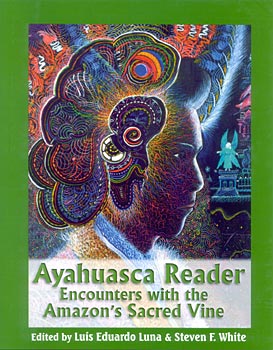
My second field of interest this year was Ayahuasca. My interest was piqued after reading an interview with ethnobotanist Wade Davis (famous for his studies of Haitian zombies and the resulting book, The Serpent and the Rainbow) and his research into native medicinal and healing plants. Ayahuasca is the generic name for a group of vines that grows wild in the Amazon and when ingested in a specially made tea concoction, induces hours long psychedelic/psychotropic visions. The drink is traditionally taken in a communal ceremony led by Amazonian shaman who oversee and guide the users with special rituals including chants, music and verbal guidance. I had a friend who tried it in South America and her experiences seemed really fascinating. Apparently, it’s like going through three years of psycho-therapy in one long overnight session. I read three or four titles on the subject but I most enjoyed the Ayahuasca Reader : Encounters with the Amazon’s Sacred Vine by Luis Eduardo Luna (Editor), Steven F. White (Editor), Steven F. White (Author), Luis Eduardo Luna (Author). It’s a collection of first hand experiences, essays and studies on the plant. The best bits are the descriptions of the Ayahuasca trips, they sound amazing – lots of brilliant colors and shapes, terrifying animals, sparkles and sometimes the vine itself speaks to them!

The image on the cover of the book is a visual interpretation of an Ayahuasca “journey.” I can’t remember but it might’ve even been drawn while under the influence of the vine. It’s very similar to Huichol art which is inspired by the ritual use of peyote.

The Year In Books: Los Angeles History

landofsunshine11.jpg

Last year’s ode to 2007 was full of fun, music and good times – this year my 2008 highlights all have to do with text: books and the internet. It’s all I’ve had time for this year. (Full-time work has been the bane of my 2008 existence, crimping my lady of leisure lifestyle and forcing me into the rigid schedule of the rat race. I would have probably adapted to this new lifestyle if I’d had more experience with the 40 hour workweek but I’m happy to say this was my first year enduring this drudgery. Why did the Haymarket Martyrs settle on 40 hours a week? Couldn’t we have taken it down to 25? There’s a project for future anarchists!) Enough of my whining, on to books!

Los Angeles History

I started the year brushing up on Los Angeles history. Of the six or so titles I read and perused, my favorite was Land of Sunshine: An Environmental History of Metropolitan Los Angeles edited by William Deverell and Greg Hise.

Review:

“Since ancient times, great cities have been shaped by their environments. But cities have also exacted their price. In these astute and very necessary essays, leading experts who are also good writers tackle important questions regarding the origins, rise, present circumstances and future sustainability of the second largest metropolitan region in the nation. No one can understand the City of Angels and its attendant communities without reference to this pioneering book.”
—Kevin Starr, University Professor and Professor of History, University of Southern California, Author, Americans and the California Dream series

My favorite chapter was The Los Angeles Prarie by Paula M Schiffman. Did you know that much of Los Angeles was difficult to traverse owing to the thousands of squirrels and ground animals that honeycombed the ground with holes and nests? Grizzlies also contributed to soil disturbances by clawing up great mounds of earth as they searched for buried food: mice, grubs, roots etc. Bears played a pivotal role in the early ecology of Los Angeles, so much so that without them, it’s impossible to recreate a pre-European Los Angeles environment. As for the Tongva, they practiced what’s been termed as “paradise by design” – a careful manipulation of plant and animal life that suited their needs while sustaining the reproduction and balance of life around them. It was all pretty good until the Europeans came and enslaved the Tongva, wiped out the grizzlies and paved the river. Thanks, guys!

whitewashed1.jpg

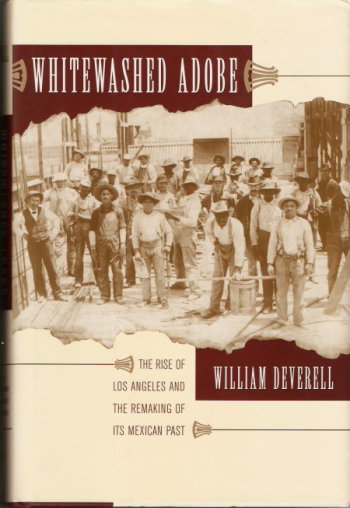
Whitewashed Adobe: The Rise of Los Angeles and the Remaking of Its Mexican Past by William Deverell is another Los Angeles history book worth mentioning. There are so many good passages I can include here but this one best sums up the purpose of this book:

Los Angeles matured, at least in part, by covering up places, people, and histories that those in power found unsettling. Los Angeles became a self-conscious “City of the Future” by whitewashing an adobe past, even an adobe present and adobe future. That whitewashing was imperfectly, even crudely, accomplished – adobe yet showed through – but it was nonetheless a way by which White Angelenos created distance (cultural and personal) between themselves and the Mexican past and the Mexican people in their midst.

Here’s a bit more:

Los Angeles is not so much a city that got what it wished for. It is a city that wished for what it worked diligently to invent. And that inventing in part entailed what this book is about, the whitewashing of other stories, other cultures, and other people’s memories on the landscape.

It’s this whitewashing and reinventing of Los Angeles by those who chose knowingly or unknowingly, to erase the history of Los Angeles’ Mexican and ethnic past, that led to the creation of a new project this year: LA Eastside.

Happy New Year!

Transit Dream

venice-beach.jpg
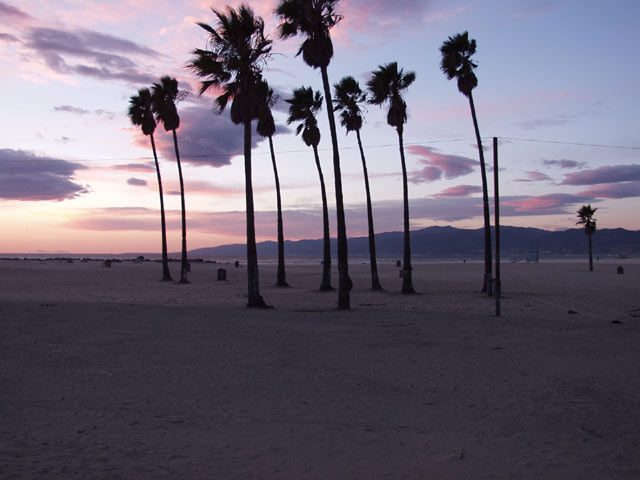
Photo courtesy of The Figurehead

It was sometime in the future, I had recently returned to Los Angeles after a long absence. I was pleased to discover not only had the Gold Line been finished but I was told the subway to the sea was also completed. I entered the Gold Line station at Mariachi Plaza in Boyle Heights hoping to get to the ocean. Around me the station teemed with thousands of Brown folks. I followed the masses down escalators, assuming they were headed to the platform where I could catch the train to the beach. The escalators kept going down, down, down and then I ended up wandering through a complicated Escher-esque maze of escalators and tunnels. Finally I could see this intense bright, light coming from the floor I was heading to. As the view became clearer, I see the ocean, so brilliant blue, the sand, the palm trees swaying and I can feel the ocean breeze. At a railing, Latino families stand admiring the vista and smiling. As I get closer, I make a shocking discovery. It’s not the ocean at all but a giant hologram, an extremely realistic simulation of the beach. No one around me seems to notice and I feel like that character in the Twilight Zone episode where a woman is yelling to the humans boarding a spaceship to another planet that the alien book titled “To Serve Man” is a cookbook not a manual for the betterment of humankind. I feel incredibly disappointed and let down. Worse yet, I look over and notice in between the teeming tunnels and escalators are stands for every fast food chain and long lines of people waiting to order.
Keep dreaming Los Angeles.

I know it’s totally self-indulgent to share dreams but I was reminded of this one after reading a subway to the sea discussion on LA Eastside.

Favorite Video of the Week: Dolores Vargas


Se Va Covadonga-Dolores Vargas

As much as I appreciate the intensity and complexity of Cante Jondo and other Flamenco, there is a special place in my heart for Rumba Flamenca. In particular, I find 60s/70s rumbas irresistible! I should be sleeping and prepare myself for a long day of work tomorrow and yet, I’m up late listening to rumbas and watching awesome clips like Dolores Vargas’ “Se Va Covadonga.” Despite the impending day of work and the miserable anticipation that goes with it, this video made me cheery for at least a few minutes. Happy holidays!
Another great rumba by Dolores Vargas here.

Villancicos


Villancicos from the film Flamenco

During this holiday season I do my best to avoid shopping malls and other places Christmas music is played. The treacly-ness of Christmas standards makes my skin crawl. However, there is a kind of Christmas music I do find enjoyable and that is Villancicos Flamencos. I first heard this kind of villancicos in the Carlos Saura film Flamenco and was struck by it’s percussive elements, in particular, the pulsing bass. In the above clip the sound is produced by an instrument called a zambomba – a barrel or jug covered by an animal hide through which the player moves a cane in rhythm with the song. In the clip below, the bass sound is made by passing a hand over a large clay jug. Other instruments commonly used in villancicos are guitars, panderetas (a kind of tambourine), castanets and of course palmas (hand clapping)

History of villancicos from the Latin American Folk Institute:

The villancico was a poetic and musical form indigenous and unique to Iberia, which developed a recognizably distinct identity by the middle of the fifteenth century. It flourished between the 15th and 18th centuries, especially during the Baroque period, both in Spain and in Spanish America. The villancico was as significant a feature in the musical landscape of New Spain (modern Mexico and Guatemala) as in the Iberian peninsula, and its development in the colonies constitutes one of the first truly American musical contributions.
According to Jaime Gonzáles Quiñones, in his scholarly publication Villancicos y cantatas del siglo XVIII, the poetic villancico derives from two related sources: most anterior was the Arabic zéjel, which he describes as a poem “written entirely in vulgar Arabic [whose] first strophe was preceded by a short poem (refrain) of two lines. The last line in each strophe followed the rhyme of the refrain.” From the zéjel descended a type of vernacular Spanish (and Galician-Portuguese) poetic form known as the cantiga de estribillo (or cantiga de refram). Gonzáles finds that the zéjel and the cantiga de estribillo, common in the fifteenth century, were most apparently similar in the occurrence of refrains (estribillo) and strophes (mudanza) which included a second part, turns (vuelta). The estribillo was especially important to the villancico style; Gilbert Chase, author of The Music of Spain, indicates that it was emblematic of the villancico that its “basic pattern rested on the device of the initial refrain” and that otherwise there could be found much latitude in the construction of its verse.

Here’s a bit on Jerez style villancicos called Zambombas (named after the instrument):

La zambomba es el lugar donde puede verse y oír cantar a aficionados anónimos que el resto del año difícilmente se pueden ver. El espíritu alegre, anárquico y desenfadado de la celebración hace que cualquiera pueda arrancarse y dejar ver su vena más flamenca.

This article also states that the participatory, communal performance of zambombas distinguishes it from other festive Flamenco songs in which there is usually a separation between the artists and the audience. In zambombas, the instrument is passed around and everyone is encouraged to join in the chorus of singers.


Villancico Sevillano-Abre La Puerta Maria

A beautiful public performance of villancicos, watch through for the aflamencado solo of one of the choral singers.

How I wish I was in Spain or Mexico tonight! I much prefer villancicos, Posadas or even this bit of silliness over the stripped-of-festivity Christmas we get here. Oh, well!

Best wishes to everyone for a Feliz Navidad!

Favorite Video of the Week: Quebradita

Over at LA Eastside there’s been a long discussion on 90s culture in Los Angeles. Commenter Metro Vaquero linked to the awesome video above of a parking lot turned dance floor in the Valley. Quebradita was crazy popular in Los Angeles during the early 90s. It was the first time in my life where listening to your parent’s music was acceptable and dressing like a Mexican was something to be proud of. The tejanas and botas are still in fashion today. And I still dream of one day dancing Quebradita…