
Letter dated March 19, 1946, Guadalajara
Among the many insights and discoveries I’ve encountered from the box of long lost letters my father recently shared with me is this letter from my paternal great-grandmother to her daughter-in-law, my Grandmother Teresa. Until I started reading these letters I knew nothing of my great-grandmother, not even her name. I was excited then when I came across the above letter and saw her name, Sara Ramos Ybarra. The V in her beautiful signature script stands for “viuda” my great-grandfather (do not know his name) passed away a few months before this letter was written. Looking forward to uncovering more family mysteries.
Favorite Song of the Day: Roni Size
New Forms-Roni Size feat. Bahamadia
I heard this song on the radio the other day and it blew me away much in the same way it had when I first heard it way back in 1997. Yes, like a lot of other folks at the time (late 90s), I was crazy about jungle and drum n bass. Roni Size was one of the best of the DJ/producer bunch and the fact that this song still sounds somewhat fresh is a testimony to his talent. It’s a shame that drum n bass came to be associated with car commercials and other despicable things. Still waiting for the jungle revival. For more on the origins of this beat, check the post on “Amen Break.”
Chalga: Part One, Azis
For so long I’ve wanted to share my love of Chalga here on this blog but I’ve always felt that it needed a proper introduction so for the past two years I’ve put it off. I kept thinking I need to re-read the Bulgarian chapters of Princes Amongst Men: Journeys with Gypsy Musicians so that I have the proper references to describe this musical style. It is this book that has the only English language research on Chalga, the Gypsy/Roma derived pop music of Bulgaria. (I approach these blog posts seriously, often doing more research for some of these posts than I would for my own papers in college and the sources for information are difficult at times to find.) I wanted to write the definitive English language reference for Chalga on the internet. Ah, what aspirations! They’ve kept me from sharing these videos all these years, despite my obsessive viewings, circle of friends chatter and Bulgarian correspondences.
Finally tonight, after a couple of glasses of my favorite wine (Marques de Riscal Rioja from Spain) I decided WTF, let’s just post up some videos of good ol’ Azis and let the mouths fall open as they may. Also, as Youtube moves on in years, more and more videos are being removed due to some kinda jerky violations and hence my grand plan of a series of Chalga video roll-outs is dwindling before my eyes. With that in mind, let’s all watch Chalga Bulgarian superstar Azis strut his stuff, shall we?
Tochno Sega by Azis and rapper Ustata
This would have been my first Favorite Video of the Week oh so many years ago but whenever I showed this video to straight male friends of mine, they freaked the f*ck out. Yes, it’s a dude who looks hot in heels and has a beard. It’s gender fuck at it’s finest and he even seduces the hip hop dude while dressed as a manly bouncer. In Princes Amongst Men, author Garth Cartwright talks about the interesting approach to sexuality in Bulgaria. Apparently, according to him, it should be obvious why the term “buggering” comes from Bulgaria. How awesome and mind blowing is it that this country, so maligned and dismissed has such a progressive perspective of sexuality which includes a significant Muslim population. Even more amazing is that it’s most beloved star, Azis comes from a Roma/Gypsy background. He has challenged not only the boundaries of his gender but also of his culture.
It is true that Chalga is not considered “serious” music, much in the way urban music like hip-hop is treated in this country. Much of this disrespect is due to the Roma origins of Chalga and it’s move away from traditional folk styles. I think similarities can be made once again with African-Americans and hip-hop. I’m not saying Chalga is even at the level of hip-hop, much of it truly is cheesy music but it does have a certain pop charm sensibility that makes me listen over and over again. Basically Chalga is a cross pollination fusion of traditional Roma ethnic music, Bulgarian folk music and Western influenced hip-hop, Reggaeton and pop styles. It started off being more rooted in the folk and ethnic styles and has gradually moved into the more Western sounding styles.
No Kazvam Ti Stiga by Azis
Phew! Is it getting hot around this blog? Don’t worry straight fellas, wait till we get to the female Chalga singers. Soft core porn is the norm for some of these videos and I’m sure they would get more risque if they could.
Lyric translation:
“only in my dreams have i had you, only in my dreams did i feel alive, only in my dreams i felt you inside of me, only in my dreams was i able to laugh”
Kazvash Che Me Obichash by Azis and Desi Slava (another famous Chalga star)
Here is small taste of the kinda cross gender sexuality that infuses Chalga videos. Wait till we get to the super hot singer Reyhan (RIP) in Chalga, Part Two!
Antigeroi by Azis
Azis has said in interviews he has great admiration for the women of Bollywood, both their singing and dancing. This video is a tribute to them and it’s a pretty catchy song too!
Teb Ochim by Azis
One of his latest songs.
In the end, this quote from one the comments on his videos sums it all up:
Many anti-gay folks have fear of their own homosexuality.
Azis is Azis.
No one can take the credit, or be ashamed collectively for him.
I am proud that Bulgaria has the open mind to accept such a crazy character. Only in a civilized culture.
Favorite Song of the Day: The Girl and the Robot
Röyksopp feat Robyn – The Girl and The Robot Listen, don’t watch
I’m not gonna promise you all that I can keep up a song a day. I feel like this blog deserves more respect than the kinda text I put up daily on my Facebook updates.
For instance, this song from the new Royksopp album, Junior featuring the fabulous Robyn was accompanied by the following on my Facebook page: “I love Robyn! I love Royksopp! I wanna have party just so I can dance to this song!” C’mon! You think I’m gonna embarrass myself like that here? Pfft.
I go mental every time you leave for work
You never seem to know when to stop
I never know when you’ll return
I’m in love with a robotIn the night, call you up and
Wanna know when you’re coming home
Don’t deny me, call me back
I’m so aloneIn the night, wait up for you
Even though you don’t want me to
Go to bed, leave the lights on
What’s the use
La Puente Ranch

My great-grandmother Matilde, her sister Trini, my great-great grandmother (and Yaqui descendant) Matilde Moreno Vizcarra, known in my family as “Nana Grande.” Photograph taken on my great-grandmother’s ranch in La Puente. (click to enlarge)
They bought the ranch after World War Two ended as a relaxing country location for my great uncle Hector who had just finished serving a harrowing stint in the Navy, part of the Pacific fleet. Unfortunately, the property was located much too near some railroad tracks and the nighttime rumbling of the trains terrified my uncle – it sounded much too similar to the war noises he thought he’d left behind. He quickly scrambled back to the original family compound in Echo Park. My great-grandmother lived in La Puente the rest of her life.
Yaqui Deer Dance
As mentioned in a previous post, a few weeks ago someone asked me if I was Native American and I answered as I often do, most people of Mexican heritage have some indigenous heritage. I think they meant Indian from north of the US border but like lots of indigenous folks, I don’t recognize these borders when it comes to culture. I was told my maternal great-grandmother was Yaqui Indian and my mother says she remembers hearing Yaqui words as a child. So in honor of my indigenous heritage, I present this video.
Yaqui Deer Dancer Yes, that is a deer head on his.
The clip is of an important ritual tradition called the Deer Dance. The festival where this dance took place was intended to bring Yaqui tribes from both sides of the borders together to celebrate their culture. There is some debate as to whether it was appropriate to film the ceremony and post the clip on Youtube. As the dance was a demonstration and not a ceremony, it seems approriate as a method to educate others in Yaqui culture.
Yaqui: Danza del Venado en Sonora, Mexico
Yaqui prefer to call themselves “Yoeme” and their homeland is “Hiakim.” It is their homeland name that most likely gave rise to the term Yaqui.
Favorite Video of the Week: Naci en el Alamo
Remedios Silva Pisa-Naci en el Alamo. Extended interview in French with filmmaker Tony Gatliff following video.
Like many, I first became acquainted to this song through the movie Vengo. It plays a pivotal role in one of the scenes and the songs perfectly echoes the heartache and loss that permeates this film. After the movie was released, many folks became obsessed with finding out more information about the singer Remedios Silva Pisa. Unfortunately, not much was available except for the rumor she recorded this song at age 16. I’ve recently tried to do a bit more research on her but have had little luck beyond what others have uncovered.
I did discover the song is originally a Greek Romani song called O balamos , balamos and was originally sung in the Greek Gypsy dialect. The title of the song eventually became known as, “To tragoudi ton gyfton,” The song of the Gypsies.
Giorgos Katsaris – To tragoudi twn gyftwn(mpalamo)
Some claim the song was composed in 1992 by Dionysis Tsaknis and performed by many famous Greek singers such George Dalaras , Paschalis Terzis, Eleni Vitali , Manolis Lidakis and the composer himself. Others say the song was originally released by an unknown singer called Yorgos Katsaris.
Yasmin Levy-Naci en el Alamo
Another popular version is by the Sephardic singer, Yasmin Levy. Yasmin’s father was Itzhak Levi, director of the Judeo-Spanish program at Kol Israel (Israel National Radio) for many years. She is well-known for her bridge building work between Jews and Arabs.
Ο Mπαλαμός – EλÎνη Βιτάλη/Haig Yazdjian
Another beautiful Greek version.
Lyrics:
No tengo lugar
Y no tengo paisaje
Yo menos tengo patria
Con mis dedos hago el fuego
Con mi corazon te canto
Las cuerdas de mi corazon lloran
Naci en alamo
Naci en alamo
No tengo lugar
Y no tengo paisaje
Yo menos tengo patria
Ay cuando canta(n), con tus dolores nuestras mujeres te hechizan
*Everywhere the title is “Naci en Alamo” but alamo could be the Gitano pronunciation of “Naci en el amor.”

Latina singers
This past week I found out some interesting facts regarding Mexicana/Latina singers I was previously unaware of:
1. The ever popular Mexicana singer Ana Gabriel is of Mexican, Chinese and Japanese descent. I didn’t always appreciate her gritty style of singing but compared to the current crop of pop singers, her vocals are most welcome.
2. Selena would have lived if she had a blood transfusion, a practice banned by her Jehovah’s Witness faith. I had never heard this story before but thanks to Cindylu, I am now acquainted with this most important bit of music history/trivia!
3. Homegirl Sara re-introduced me to a fine bit of music this weekend. According to her and others, Amanda Miguel was considered a feminist for singing this angry song which translates into: He Lied to Me. Damn, she has a fierce style too!
El Me Mintio by Amanda Miguel She’s Argentinean! I’m so wrong these days.
Maybe all of these facts are common knowledge but I never paid much attention. Much of this music was in the background of my life, familiar but unrecognized. I feel like it’s time I gave it some respect.
Blue Tears
My favorite song of the day: Blue Tears by Cryptacize
From the Cryptacize website:
Cryptacize deals in the unforgettable melody, the forsaken chord and the extravagant sentiment. They offer a distinct kind of pleasure; it’s not casual background or ‘lifestyle’ music. Nedelle Torrisi’s surefooted and richly nuanced vocal arabesques, like a modern day Freddie Mercury or Ronnie Spector, strangely complement Chris Cohen’s guitar, maniacally sped-up a la Les Paul or staccato and funny like Roy Smeck or Adolph Jacobs of the Coasters. Michael Carreira’s syncopated drum corps rudiments and pit-orchestra rave-ups propel the songs with a refreshingly buoyant touch that never lapses into rock music cliches.
Their blog.
Fallen Tree
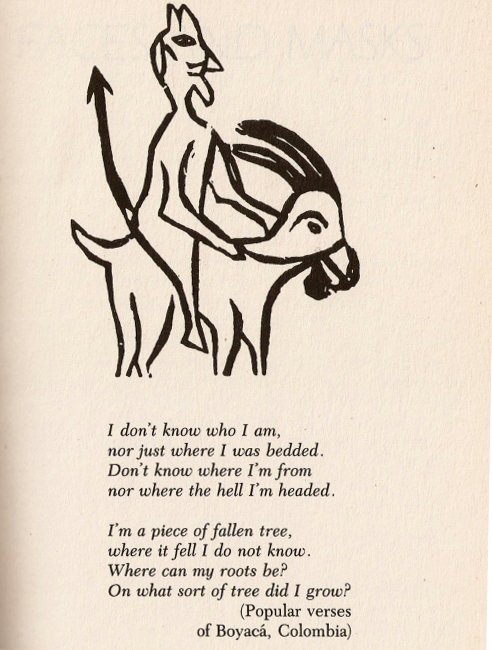
From Eduardo Galeano’s Faces and Masks, part two of the Trilogy of Fire series. One of my all-time favorite books and author.