Los Huehuentones & La Cultura Mazateca


Huehuentones performing in Oaxaca City, Mexico, 2007

Last year, I spent a festive Dia de los Muertos in Oaxaca City, Oaxaca. During the week long celebrations, representatives of the various indigenous groups from the region head to the center of the city to perform music and share their cultural traditions, most notably the display of altars. Of all the various musical groups that performed in the zocalo, the group I was most impressed with were the boisterous and playful Mazatecos from Huautla de Jimenez, Oaxaca. They moved through the crowds dancing, singing, hooting and pulling startled European women from the crowd to dance with them. What I especially appreciated about this music, besides it’s liveliness and the awesome masks they perform in, were the violins, as can be heard in the clip I took above. For a longer video of these particular musicians, please see here. (I suggest starting at the three minute mark).


Ventana a Mi Comunidad: Huehuentones

The costumes and masks used in this celebration are part of the Mazateco Dia de los Muertos traditions and are called Huehuentones. The charming boy in the clip above explains (in his native Mazateco and in Spanish) Huehuetones are depictions of gente de ombligo, people from the navel, as they are believed to have sprouted from the center of the earth. The Huehuentones masks depict various animals and other characters and are made from wood, paper mache and tree bark. You can also see the influence of Halloween masks in some of the Huehuentones costumes.


Ventana a Mi Comunidad: Silbando entre los Montes

Mazatecos also have an amazing way of communicating in their mountainous, highland towns, they whistle! The whistling is understood because their spoken language is tonal. In fact, speakers of the various dialects often have trouble understanding each other due to tonal variances. The clip above gives an example of a whistled conversation.


Ventana a Mi Comunidad: Dia de Plaza

This section of video shows a market day in a Mazateco village, narrated by another equally charming boy in his indigenous inflected Spanish. Popular foods of the region are chayote, yucca, yams, achiote, guavas and various other fruits and vegetables that I am unfamiliar with, including a giant seed pod filled with cotton ball looking sweet fruits. Another interesting fruit is the huasmole which is mashed up and cooked with yerba santa* (an anise like herb) and steamed in banana leaves.


Baile Flor de Naranja, Huautla de Jimenez

However, it is this video above that best reflects a real Mazateco celebration. A simple party in the middle of the house with the soon to be eaten food, including a live turkey, given special honors on the dance floor. The dancing abuelita with the silver trensas is the star of the show and my new hero. Like her, I want to be able to fall on my butt, get up and continue the party! I never want to be too old to dance, sing and laugh.

By the way, Huautla de Jimenez is best known for the infamous Maria Sabina, a curandera who used psilocybe mushrooms in healing vigils called veladas (click for mp3 samples). You might have seen the ubiquitous t-shirts of her smoking a joint, sold at various tourists shop in Mexico.

*If anyone knows where I can buy a yerba santa plant, please tell me. I’ve been looking for ages!

Favorite Video of the Week: X-Ray Spex


Excerpt from The Punk Years

I was planning to write this big long thing about X-Ray Spex but this documentary should explain why they are one of my all time favorite bands. I first heard “Oh Bondage, Up Yours” (a feminist critique of bondage, by the way) when I was 13 and the music totally captivated me. Drawing on the Situationists, the lead singer, Poly Styrene was decades ahead of her time with her critiques of consumerism and her eco-consciousness. Even to this day, there are very few bands whose lyrics are as political and witty. Also, she was one of the first punk rock women of color, very important to me when I was young, as I saw a little of myself in her. I used to be so into them that I had a crush on a guy in high school just because he was the only person I knew that owned an X-Ray Spex t-shirt. The saxophones, the cracking of Poly’s voice, the sing-a-long melodies are all small auditory treasures I continue to enjoy again and again!


Live at the Hope & Anchor, part one (documentary by British television)


Live at the Hope & Anchor, part two

Favorite Video of the Week: Dungen

Among the many genres of music I follow, there’s a special place in my heart for post-psychedelic music.
Last year, I first heard Dungen’s Sa Blev Det Bestamt with it’s surprising nod to Turkish psychedelic rock but I hadn’t paid much attention to the rest of the album. Lately, I’ve been giving the album a second listen and I’ve been blown away by some of the songs, in particular Familj (above). It’s the keyboard/organ on this track that’s pulled me in, plus it kinda reminds me of another favorite group, Can (see below). I know everyone thought Caribou’s foray into psychedelia, Andorra was the 2007 record of the year but now I’m liking Dungen’s Tio Bitar much more.

And for the fun of it, I just found this on youtube, one of my all-time favorite songs ever!

Oh Yeah-Can

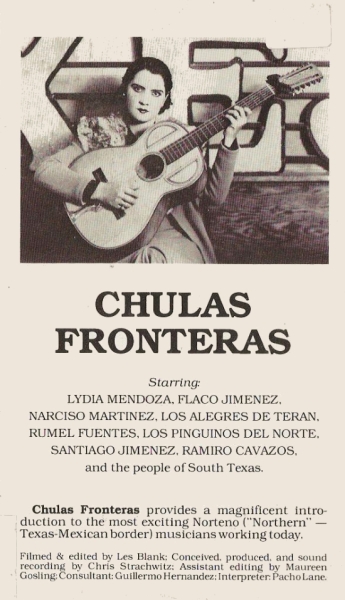
Chulas Fronteras

chulasfronteras2.jpg

I’ve recently taken a small diversion from Flamenco and electronic music to explore the realms of Border music. I think it has to do with my ongoing nostalgia for the Southwest. A few years ago, I took trips to Arizona and New Mexico to do some genealogical research and left feeling connected to that geographic area, the roots trailing behind me on the highway home. Unfortunately, I no longer have immediate family in the region, but I’m sure Tucson is filled with distant relatives I will probably never meet. These trips and my on-going genealogical investigations inspired my new found interest in border music.
These emotions were stirred up recently when I watched the Arhoolie produced video, Chulas Fronteras.

“’Chulas Fronteras’ provides a magnificent introduction to the most exciting Norteña (“Northern” Texas-Mexican border) musicians working today: Los Alegres de Teran, Lydia Mendoza, Flaco Jimenez and others. The music and spirit of the people is seen embodied in their strong family life and sheer enjoyment of domestic rituals preparing of food and eating, celebrating a 50th wedding anniversary, gathering in the backyard with friends. At the same time Blank does not overlook the hardships, in particular the Chicano experience of migrating from state to state with the seasons for work in the fields. He makes clear the role that music has in redeeming their lives by giving utterance to collective pain. For music, politics and life are integrated in this film in a way that is both enchanting and unsettling.”


Narciso Martinez from Chulas Fronteras

The opening scene shows some Tejanos on a make shift ferry (basically what looked to be a raft of wooden pallets) pulling their truck across the Rio Grande/Bravo. Rope is strung between the shores, which the men use to pull the ferry and the truck, across by hand. The DIY ingenuity continues during a scene of a bar-b-que tardeada showing these same men as they prepare, for what looks to be, a fine meal. While one grinds chiles in a molcajete, the other improvises and uses his beer bottle and bucket as a mortar and pestle to pulp roasted tomatoes for his salsa. There’s also a great scene of legendary Lydia Mendoza (RIP) making tamales in her kitchen. This is a music documentary mind you, but these small vignettes of Tejano life are what make the music and the subjects so compelling.
As for the music itself, there’s plenty of corridos, norteños and rancheras to accompany the various life scenes. All the lyrics are translated too. I particularly enjoyed the scenes of the live performances and the dancing couples in Tejano salons and niteclubs. (I consider my life somewhat tragic for never having learned to properly dance to corridos, nortenos or for that matter, any other dance that requires a partner.) Perhaps if I watch the documentary enough, I can pick up a few steps!
I’m grateful for filmmakers like Les Blank who had the foresight to capture these cultural moments in time and create audio visual treasures like Chulas Fronteras.
The video is generally available on the internet and at the Los Angeles Public Library.
Chulas Fronteras with:
Lydia Mendoza, Flaco Jiménez, Narciso Martínez, Los Alegres de Teran, Rumel Fuentes, Don Santiago Jiménez, Los Pinqüinos Del Norte, Ramiro Cavazos (Canción Mixteca)
and others.

Filmed in South Texas.

My Parents Never Listened to this Music: 70s Spanish Pop Ballads


Porque Te Vas scene from the film Cria Cuervos

My love for cheesy Spanish 70s pop ballads started with this song, one of my all time favorites, Jeanette’s Por Que Te Vas. My introduction to this wistful melody was through the dark and melancholy 1976 film, Cria Cuervos. In the movie, the young girl Ana uses the song as way to escape the dreariness and sorrow of her family life (an allegorical stand in for fascist Spain). Ana’s father, a fascist military man has recently died (she believes she has poisoned him) and her dead mother who died a few years before, comes to Ana as a phantom memory. Her authoritarian aunt and dying grandmother are left to look after her but her real life lessons come from the anarchistic housekeeper. In the midst of this turmoil, young Ana begins to mix reality with fantasy and at times, her older self of the future speaks to her:

I don’t believe in childhood paradise, or in innocence, or the natural goodness of children. I remember my childhood as a long period of time, interminable, sad, full of fear, fear of the unknown.

In this context, the song is transformed and the lyrics “Hoy en mi ventana brilla el sol/ y un corazon/ se pone triste contemplando la ciudad/ por que te vas” take on more meaning than Jeanette could ever have imagined.

The director of Cria Cuervos, Carlos Saura went on later to make a number of fantastic flamenco themed movies.
[As an aside, for another take on childhood-turned-on-it’s-head movies, I totally recommend Terry Gilliam’s Tideland, an all time favorite of mine. Not for those that are squeamish, easily offended or have delicate sensibilities. Coincidentally, in both films the young protagonists have interactions with little critters. In Tideland, Jeliza-Rose is taunted by a squirrel and in Cria Cuervos, Ana is attached to a pet guinea pig. ]

On to more music!>>>>>
(warning, lots of videos after the jump)
Continue reading

Casa Xochiquetzal

combi_bar2.JPG
Emergency bar in a combi/mini-bus, Nezahualcoyotl

It’s rare when something can move me to tears…okay, not that rare. I’m a regular crybaby but I couldn’t stop the tears after watching this short documentary on a sex workers retirement home (well, despite their age, some have not yet retired) in the Tepito neighborhood of Mexico D.F. It’s produced by Vice but don’t let that dissuade you, it’s very well done.

Part One
Part Two
Part Three

Favorite Video of the Week: La Mentira


La Mentira-Javier Solis

The other day I was talking to a friend of mine about music, when I made the most stupid remark ever. I said, “I don’t like romantic music.” I regretted it as soon as I said it. I absolutely love Boleros, music that can only be described as romantic. I love Flamenco, heart-wrenching melodramatic Italian arias, Kings of Convenience, Bossa Nova and I love this song! It’s one of my mom’s favorites and she had me sing it on her new karaoke machine the other day (much more fun that it sounds!). I’m familiar with the tune but it wasn’t until I actually attempted to sing it that I realized what a beautiful piece of music it is, very different than other Musica Romantica melodies. Javier Solis’ interpretation is my favorite.
Continue reading