Röyksopp feat Robyn – The Girl and The RobotListen, don’t watch
I’m not gonna promise you all that I can keep up a song a day. I feel like this blog deserves more respect than the kinda text I put up daily on my Facebook updates.
For instance, this song from the new Royksopp album, Junior featuring the fabulous Robyn was accompanied by the following on my Facebook page: “I love Robyn! I love Royksopp! I wanna have party just so I can dance to this song!” C’mon! You think I’m gonna embarrass myself like that here? Pfft.
I go mental every time you leave for work
You never seem to know when to stop
I never know when you’ll return
I’m in love with a robot
In the night, call you up and
Wanna know when you’re coming home
Don’t deny me, call me back
I’m so alone
In the night, wait up for you
Even though you don’t want me to
Go to bed, leave the lights on
What’s the use
As mentioned in a previous post, a few weeks ago someone asked me if I was Native American and I answered as I often do, most people of Mexican heritage have some indigenous heritage. I think they meant Indian from north of the US border but like lots of indigenous folks, I don’t recognize these borders when it comes to culture. I was told my maternal great-grandmother was Yaqui Indian and my mother says she remembers hearing Yaqui words as a child. So in honor of my indigenous heritage, I present this video.
Yaqui Deer Dancer Yes, that is a deer head on his.
The clip is of an important ritual tradition called the Deer Dance. The festival where this dance took place was intended to bring Yaqui tribes from both sides of the borders together to celebrate their culture. There is some debate as to whether it was appropriate to film the ceremony and post the clip on Youtube. As the dance was a demonstration and not a ceremony, it seems approriate as a method to educate others in Yaqui culture.
Yaqui: Danza del Venado en Sonora, Mexico
Yaqui prefer to call themselves “Yoeme” and their homeland is “Hiakim.” It is their homeland name that most likely gave rise to the term Yaqui.
My favorite song of the day: Blue Tears by Cryptacize
From the Cryptacize website:
Cryptacize deals in the unforgettable melody, the forsaken chord and the extravagant sentiment. They offer a distinct kind of pleasure; it’s not casual background or ‘lifestyle’ music. Nedelle Torrisi’s surefooted and richly nuanced vocal arabesques, like a modern day Freddie Mercury or Ronnie Spector, strangely complement Chris Cohen’s guitar, maniacally sped-up a la Les Paul or staccato and funny like Roy Smeck or Adolph Jacobs of the Coasters. Michael Carreira’s syncopated drum corps rudiments and pit-orchestra rave-ups propel the songs with a refreshingly buoyant touch that never lapses into rock music cliches.
As you might have noticed, some aesthetic changes are underway on this blog. Changes not entirely by choice, it happened when I upgraded wordpress. I don’t think this look suits me but it will have to do for the time being. Welcome to Helevetica hell!
Since I am here I decided to share with you a song I’ve just heard today and instantly fell in love with. It’s from Fever Ray, a solo project of Karin Dreijer Andersson, one half member of The Knife. The album won’t be out until March but you can hear some of the songs on the Fever Ray website.
The video is absolutely brilliant, as British friends like to say. It looks like my dreams.
I once heard this interview with John Waters where he said he loves any song sung by girls that sound as if they had a cold. I totally agree. I’m glad to see plastic crates can be used for more than just books and record.
Ankle Injuries-Fujiya & Miyagi
Once in rare while I might think of myself as creative and then I watch videos like this and realize I have so little talent.
Milk Crisis-The Go! Team
I knew I forgot one. More happy music.
LA, CA, USA-Stereototal
One more! And finally a chance to include a clip from one of my all time favorite bands, Stereototal!
I was recently joking that I’d love to have my own radio station that played nothing but electronic music from disco to house to idm to electro clash and everything else in between. IDM, Intelligent Dance Music was a term used around the turn of the century (2000) to describe a kinda of music that was less shlocky and more refined than the techno being produced at this time. Some IDM moved into a sub genre called “glitch.” Glitch is the kinda music you play if you really want to irritate your parents. Guitar rock doesn’t work anymore cause that’s what they listen to. Glitch would drive them crazy! Anyways, Plaid is one of the better bands that emerged from the IDM scene but Boards of Canada are still my favorite. When I first heard the song Eyen, I must’ve listened to it a hundred times in a row, I was so infatuated with it. It’s nice to hear it again after all these years.
Smack My Glitch Up-Kid 606
This is a very tame and listenable glitch track by master Kid 606. Even I can’t really listen to his albums all the way through. I admit I really loved the track sampled in this song as well – I don’t care if Kylie Mynogue is a pop princess. Here’s Kid 606’s excellent glitch version of Straight Outta Compton.
My Red Hot Car-Squarepusher
Squarepusher also experimented a bit with glitch elements in this favorite track of mine. More Squarepusher beats to rattle your nerves here.
Tricky Disco-Tricky Disco
A long time ago when I was still a teenager, back after I stopped being a punk rocker (a good chunk of my friends turned into nazi skinheads) and gave up on cholos (two of my boyfriends ended up in jail), I took a job at the now defunct Robinson’s department store downtown on 5th street where I met all these super friendly gay Latino guys. They started taking me to clubs and what they called “underground parties” which were the precursors to the rave scene here in Los Angeles. These parties were usually put on by groups of British DJs and attended by a subculture art crowd. It really was an anything go type of scene and reminded me of the early experimentations of punk. The original parties were set up in abandoned downtown warehouses and you needed to go to the map location to get the directions and address. The parties usually started around midnight would go till dawn and sometimes longer. There were never any adequate bathroom facilities but the $5-$10 entrance usually came with free booze. Tracks like Tricky Disco and LFO were some of my favorite songs from this era. I corresponded with DJs in London who’d send me these awesome mix tapes (some live radio recordings from offshore illegal pirate stations out at sea) that my mom would call “alarm clock music.” It was a fun time in my life. Eventually, straight guys and normal people started discovering raves and it turned into a whole different scene with the usual crap that goes along with it. I moved on too.
Alexander Robotnick – Obsession for the disco freaks
I’m including this video for a few reasons. One, Alexander was nice enough to put the video up on my chimatli mix myspace page. But also, because he was one of the innovators of Italo Disco and it’s amazing to see him still making music. Like him, I’ve spent many hours at record shops flipping through vinyl, looking for that elusive album. It’s a nice tribute to DJs and vinyl junkies.
During this holiday season I do my best to avoid shopping malls and other places Christmas music is played. The treacly-ness of Christmas standards makes my skin crawl. However, there is a kind of Christmas music I do find enjoyable and that is Villancicos Flamencos. I first heard this kind of villancicos in the Carlos Saura film Flamenco and was struck by it’s percussive elements, in particular, the pulsing bass. In the above clip the sound is produced by an instrument called a zambomba – a barrel or jug covered by an animal hide through which the player moves a cane in rhythm with the song. In the clip below, the bass sound is made by passing a hand over a large clay jug. Other instruments commonly used in villancicos are guitars, panderetas (a kind of tambourine), castanets and of course palmas (hand clapping)
Here’s a bit on Jerez style villancicos called Zambombas (named after the instrument):
La zambomba es el lugar donde puede verse y oÃr cantar a aficionados anónimos que el resto del año difÃcilmente se pueden ver. El espÃritu alegre, anárquico y desenfadado de la celebración hace que cualquiera pueda arrancarse y dejar ver su vena más flamenca.
This article also states that the participatory, communal performance of zambombas distinguishes it from other festive Flamenco songs in which there is usually a separation between the artists and the audience. In zambombas, the instrument is passed around and everyone is encouraged to join in the chorus of singers.
Villancico Sevillano-Abre La Puerta Maria
A beautiful public performance of villancicos, watch through for the aflamencado solo of one of the choral singers.
How I wish I was in Spain or Mexico tonight! I much prefer villancicos, Posadas or even this bit of silliness over the stripped-of-festivity Christmas we get here. Oh, well!
Best wishes to everyone for a Feliz Navidad!
Over at LA Eastside there’s been a long discussion on 90s culture in Los Angeles. Commenter Metro Vaquero linked to the awesome video above of a parking lot turned dance floor in the Valley. Quebradita was crazy popular in Los Angeles during the early 90s. It was the first time in my life where listening to your parent’s music was acceptable and dressing like a Mexican was something to be proud of. The tejanas and botas are still in fashion today. And I still dream of one day dancing Quebradita…
I’ve recently taken a small diversion from Flamenco and electronic music to explore the realms of Border music. I think it has to do with my ongoing nostalgia for the Southwest. A few years ago, I took trips to Arizona and New Mexico to do some genealogical research and left feeling connected to that geographic area, the roots trailing behind me on the highway home. Unfortunately, I no longer have immediate family in the region, but I’m sure Tucson is filled with distant relatives I will probably never meet. These trips and my on-going genealogical investigations inspired my new found interest in border music.
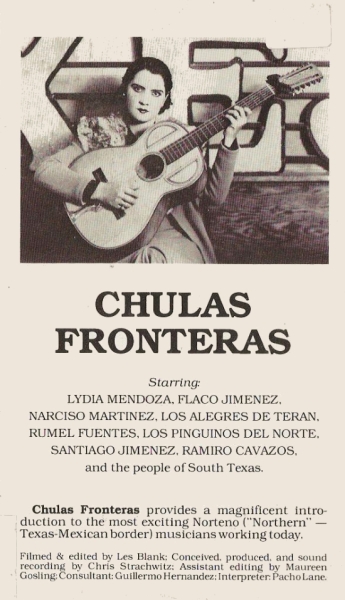
These emotions were stirred up recently when I watched the Arhoolie produced video, Chulas Fronteras.
“’Chulas Fronteras’ provides a magnificent introduction to the most exciting Norteña (“Northern†Texas-Mexican border) musicians working today: Los Alegres de Teran, Lydia Mendoza, Flaco Jimenez and others. The music and spirit of the people is seen embodied in their strong family life and sheer enjoyment of domestic rituals preparing of food and eating, celebrating a 50th wedding anniversary, gathering in the backyard with friends. At the same time Blank does not overlook the hardships, in particular the Chicano experience of migrating from state to state with the seasons for work in the fields. He makes clear the role that music has in redeeming their lives by giving utterance to collective pain. For music, politics and life are integrated in this film in a way that is both enchanting and unsettling.â€